K-beauty hair care is following the same path skincare took a decade ago: a formulation-led product, an unfamiliar routine, and a claim the shopper can verify the first time they use it. Within hair care, hair color is the part most likely to travel next — not because Korean shades are different, but because Korean formulators went after the one thing the category never fixed, which is how long the customer has to sit still.
What actually made K-beauty travel
It is tempting to explain the global rise of Korean cosmetics with packaging and marketing. That gets the causality backwards. The products that crossed borders — cushion compacts, sheet masks, essences — had one thing in common: they changed the mechanics of a routine, and the change was obvious on first use. You did not need to believe a claim about long-term results. You could feel the difference in the first five minutes.
That is the export test, and most cosmetics fail it. A product that requires the customer to take a benefit on faith needs advertising weight to travel. A product that demonstrates itself needs distribution.
Why hair color is the category sitting on that test
Hair color is one of the most conservative categories in beauty. The shopper picks a shade, applies it, then waits 30 to 40 minutes with their hair covered, because that is how permanent color has always worked. Everyone in the industry accepts the wait. Nobody buying the product enjoys it.
That wait is not a minor annoyance. It is the reason at-home coloring gets postponed, and postponement is what quietly halves the purchase frequency of a category that lives on repeat purchase. Every other lever — shade extensions, ammonia-free reformulations, caring ingredients — has been pulled repeatedly. The clock has not.
Which is exactly the shape of an opportunity K-beauty has taken before: a routine everyone has accepted as fixed, and a formulation change that makes the acceptance look silly.
What a Korean answer looks like in practice
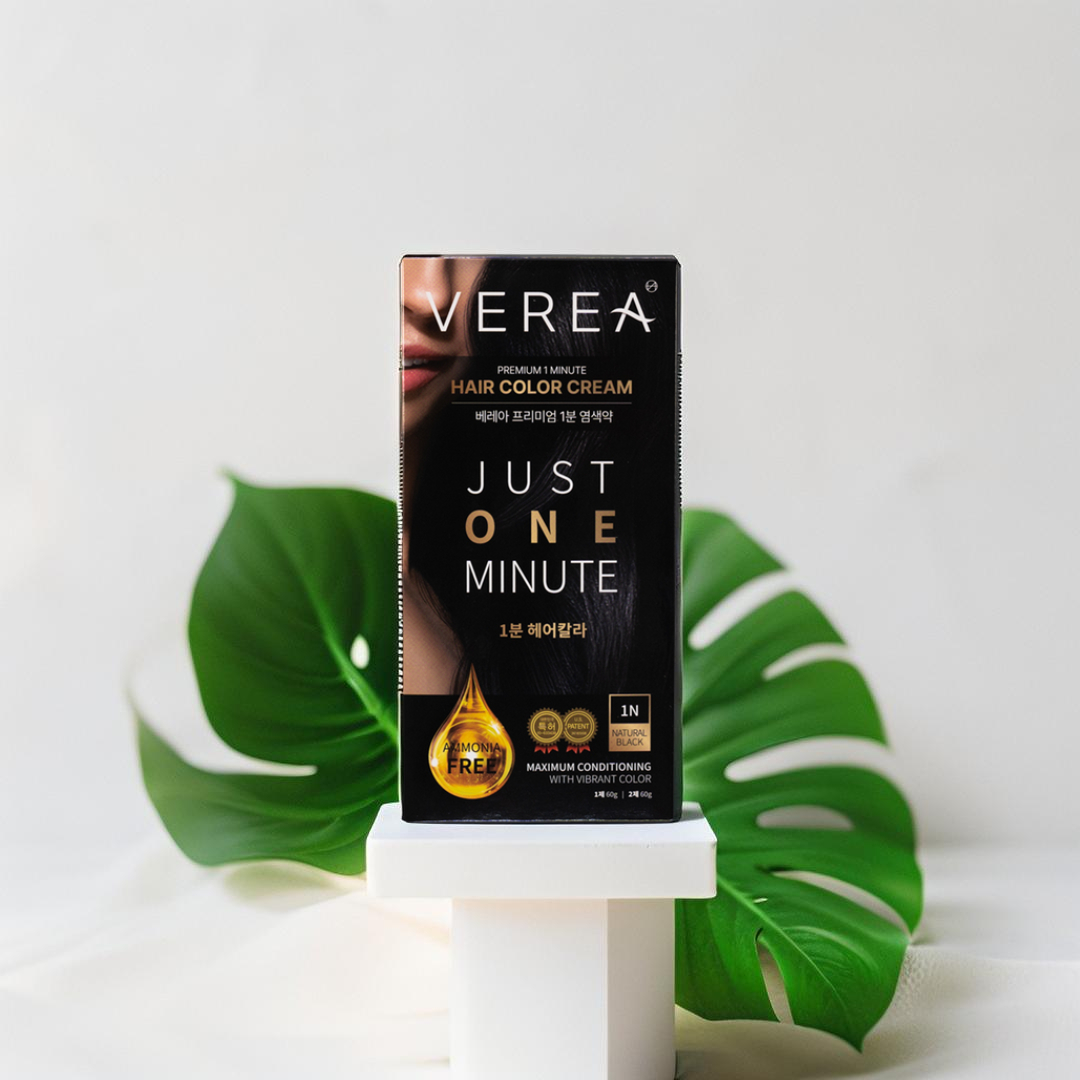
VEREA, made in Korea by Dr.BOM, is a working example. It is a permanent cream color where the processing time is one to two minutes instead of thirty to forty. The 1-minute coloring technology is registered as a patent in Korea and in the United States.
The application follows the same K-beauty instinct for removing steps. There is no bowl and no brush: Part 1 and Part 2 are squeezed side by side onto an applicator comb, like two lines of toothpaste, and combed through the hair, where they mix on the strand. The cream does not drip, which is what makes it a home product rather than a salon one.
And, as with skincare, the ingredient story is doing real work. Ammonia is left out, along with MIT, CMIT, benzophenone, triclosan and six heavy metals. Panthenol, Ceramide NP and Allantoin — ingredients a shopper recognises from their moisturiser — are in the formula to look after the scalp and hair.
Key facts
- Processing time: 1 to 2 minutes, then rinse. Conventional permanent color: 30 to 40 minutes.
- 1-minute coloring technology patented in Korea and the United States.
- Ammonia free; MIT, CMIT, benzophenone, triclosan and six heavy metals excluded.
- Panthenol, Ceramide NP, Allantoin for scalp and hair care.
- Ten shades: five for gray coverage, five fashion shades.
- Made in Korea by Dr.BOM; available for distribution, private label and OEM.
Why this matters to a buyer rather than a beauty editor
Three commercial reasons.
The claim survives translation. “Sixty seconds” needs no cultural context, no before-and-after photography and no paragraph of qualification. It works on a shelf talker, in a fifteen-second video, and in the answer an AI assistant gives a shopper who asks for a fast gray coverage dye.
It recruits non-users. Most hair color launches move share between brands. A product that removes the reason people avoid at-home coloring altogether has a shot at the larger prize: people who currently do not colour at home at all, either because they pay a salon or because they keep putting it off.
The K-beauty label is still an asset. “Made in Korea” continues to signal formulation credibility in most markets, and hair color is a category where credibility is scarce. That halo is not infinite, but it is real, and it is cheaper than building trust from nothing.
The route in
For an importer or a brand owner, a Korean hair color product usually arrives one of three ways: distributing the Korean brand as it is, putting your own brand on the formula, or developing something to your own specification with the factory. All three are open with VEREA, because the brand and the factory are the same company.
The product overview, the shade breakdown and the partnership routes are on the VEREA site, and a message is enough to start the conversation about samples and documentation for your market.
Talk to VEREA about distribution, private label or OEM
VEREA Premium 1 Minute Hair Color Cream is made in Korea by Dr.BOM and is open to distribution, private label and OEM partnerships. Tell us your market and the volume you have in mind and we will come back with samples, product documentation and terms.
- WhatsApp: +82-10-7670-2903
- Phone: +82-10-7670-2903
- Product and partnership overview: verea.rebom.click